Coronary Angiogram

What is an Coronary Angiogram?

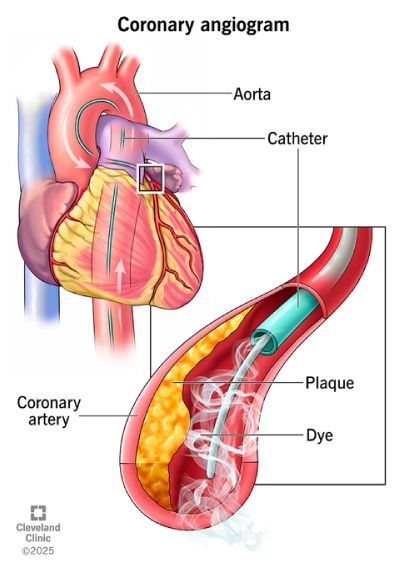
A Coronary Angiogram is a procedure where special X‐ray of your heart’s arteries is taken to see if they are narrowed or blocked. A catheter (a long tube) is inserted into an artery in the wrist or groin and is moved up inside your artery until it reaches your heart. A special dye is then injected into the tube and x‐ray images are taken as the dye is pumped through your heart and coronary arteries (the arteries supplying blood to your heart). These X‐rays give clear and accurate information about the state of your heart and coronary arteries.
What to expect before your procedure

Please note this booklet provides general information about your procedure. The hospital booking team will contact you prior to your procedure with personalised instructions specific to your medical history.

Before

Your Cardiologist may request a blood test.

You may be asked to stop taking some medications.

You are required to fast for 6 hours prior to your procedure.

If you are a diabetic, please contact us for specific instructions.

Please pack an overnight bag should you be required to stay overnight for observation.

On the day of your procedure

Make transport arrangements to and from the hospital as you won’t be able to drive after the procedure.

Arrive at the Hospital at least two hours prior to your procedure.

During the procedure

You are not required to be under full anaesthetic during this procedure, however you may be given a sedative.

A small incision is made in your leg or wrist, where your cardiologist will insert a catheter and guide it up through to your heart. Local Anaesthetic will be used to numb the area of incision.

The team will then inject the dye to examine the flow of blood through your coronary arteries. This information is displayed on a large monitor within the theatre and recorded for observation and reporting.

You will be taken to a recovery area for observation and monitoring. When your condition is stable, you will be moved to a patient room where you will be monitored regularly. You will need to lie flat for one hour to ensure optimal healing of the catheter incision site.

In order to support your recovery, your cardiologist will, in most cases be able to provide you with your results on the day.

Post procedure care & discharge information

If you are discharged on the same day as your procedure, ensure someone is able to stay overnight with you.

A full report will be sent to your Doctor regarding the results of your procedure.

Drink plenty of fluids to promote recovery.

Do not participate in strenuous activities such as; sports, housework, heavy lifting etc for at least 2 days.

Contact our rooms on 08 9389 8658 to book a post procedure follow up for 4 to 6 weeks’ time (or according to the instructions given to you by your cardiologist).

Important information

Please seek URGENT medical care by visiting your closest Emergency Department if you experience any of the following:

Chest pain or shortness of breath that does not go away with rest

Fever or chills

Bleeding or new bruising or swelling at the incision/catheter site

Light headedness or vision impairments.

Increasing pain or discomfort.

Any feeling of numbness, tingling, change in skin colour or weakness that develops in your legs.

Important Contact Information

Should you have any queries relating to your procedure, patient care or hospital admission, please contact our office on:
p. 08 9389 8658 – press option 1 and 2
OR
email: hospital.bookings@accesscardiology.com.au